The Same Grievance
Praevention-Resilienz
Manosphere influencers and Islamist actors exploit the same grievance among young Muslim men. Where protection turns into control.

This essay is based on a talk Engin Karahan gave on 20 November 2026 in the session “Experiences of Racism and Masculinity” at the International Conference on Boys and Men “Looking for Direction”, hosted by the German Federal Ministry of Education, Family, Senior Citizens, Women and Youth in Berlin. A German version is available here.
The International Conference on Boys and Men, hosted by the German Federal Ministry for Family Affairs in Berlin on 20 November, asked where young men find direction between old role expectations and new perspectives. In the session on experiences of racism and masculinity I followed these experiences to a place where young men spend a great deal of their time, the feed on their phones. My argument is that manosphere influencers and Islamist actors take up the same grievance among young Muslim men and make them a similar offer of strength, dignity and belonging, one that in the end is tied to control over others.
Who answers young men
The manosphere owes its success less to the cleverness of its answers than to the fact that it answers at all. Many young men ask questions that are rarely spoken aloud in schools, youth services, mosques and civic education, such as what makes them a man, how to deal with rejection and where to find recognition without constantly having to prove themselves. Very often these questions are answered first by the feed. There they meet men who have turned grievance into a business model.
From official discourse a young man mostly hears prohibitions, telling him not to be toxic, not to be patriarchal and not to be the problem. The manosphere tells him the opposite, that his pain is real, that society has cheated him and that it will teach him how to become strong again. This story is dangerous, yet it has one advantage over many democratic alternatives, because the young man actually appears in it. Why a raised finger achieves little against it is something I described in more detail in May.
Young Muslim men face this from two sides. From the outside they are quickly marked as a problem group, while from the inside they are often expected to be strong, to represent the family, to earn money, never to show weakness and to defend the community. In digital spaces they meet actors who bundle all of these expectations and charge them ideologically.
Two images of the same young man
For young Muslim men, experiences of racism are very often gendered. The Independent Expert Group on Anti-Muslim Hostility1 describes how anti-Muslim prejudice rests on the attribution of a patriarchal image of men, on dominance, readiness to use violence and the assumption that Muslim men oppress their wives. Since New Year’s Eve 2015 in Cologne, the sexually dangerous young Muslim man has been a recurring figure in German debates on migration.
Islamist channels answer with the mirror image. The West supposedly wants to make the Muslim man soft, with feminism and queer visibility as its tools. Neither image leaves room for an ordinary young man who neither dominates nor gives himself up. The Islamist offer starts at this gap. What the majority calls patriarchal is reinterpreted as honour, protection and religious duty and set against a West that is supposedly weak. The suspicion a young man meets as a man thus becomes his entry point to a masculinity based on control. This is what I mean by the same grievance. It underlies the distinction that matters most to me in this field, the one between experiences of racism and their instrumentalisation.
A religious garb for a global pattern
Much of what appears as Islamic in these channels is better explained sociologically than theologically. Red Pill logic, the high value man and the aesthetics of the TradWife come from secular online milieus, many of them American, and are given a selected verse or hadith only afterwards in Muslim spaces. Some influencers copy Andrew Tate almost one to one, put on a kufi and quote a hadith. The high value man becomes the pious patriarch, control becomes protection, the logic of possession becomes responsibility and the subordination of women a supposedly God-given order, as the Trend Report 2/2026 of the Behind the Feed project2 describes (p. 18).
Religious terms are turned around as well. Protective jealousy, ghīra, is twisted so that a man who does not control his wife’s clothing, phone and contacts supposedly does not love her and has no honour, which makes him a dayyūth. The Qur’an addresses lowering the gaze to men first (24:30), as a practice of self-discipline. In these videos it is turned against women when a man declares that he has to lower his gaze because she dresses so provocatively.
I consider this a form of mimicry, in which a globally circulating patriarchal ideology looks for a local religious garb. It does not follow that young Muslims are particularly susceptible, since what works here is the religious disguise of a pattern that reaches their non-Muslim peers just as well. At the same time religious authority shifts from trained scholars to whoever has reach. The Vienna-based theologian Tuğrul Kurt has put it in one sentence, saying that today viral is the new ṣaḥīḥ (quoted in the trend report, p. 20). What images of masculinity mean for the prevention of radicalisation is something I set out elsewhere in the spring.
Racism as a lever
This is where experiences of racism become a lever. In the material analysed in the trend report, the framing of one’s own community as a victim accompanies almost every narrative, from the delegitimisation of Israel to the rejection of democracy (p. 15). Discrimination is instrumentalised where it becomes proof that only one’s own group offers protection. A particularly resonant story claims that the German state wants to turn Muslims into “different Muslims”. One of those who spread it is Suhaib Hoffmann from the group Realität Islam, which is counted among the circle of Hizb ut-Tahrir, an Islamist movement that the Federal Ministry of the Interior3 banned from any activity in Germany in 2003. Since the group dissolved in 2025, its channels have continued under his name (trend report, p. 7). He presents an anti-Islamic graffito as a “consequence of the anti-Islamic assimilation policy” (p. 14). In this way real events such as headscarf debates, anti-Muslim incidents or Islamic religious education are tied to the claim of a planned theft of identity.
Criticism of pressure to assimilate, of discrimination and of double standards is legitimate and no sign of radicalisation. It becomes ideological only where it is built up into a conspiracy narrative of identity theft from which a religious duty to withdraw is supposed to follow.
Where first contact happens
Radical actors rarely begin with a worked-out ideology. Often they start much lower, with self-improvement, discipline, promises of status, belonging and an explanation for one’s own powerlessness. First a need is addressed, and only then is a worldview offered in which grievance becomes a frame of interpretation, insecurity becomes an enemy image and the wish for strength becomes an offer of dominance.
Masculinity content mostly sits outside the classic Islamist categories. It appears in relationship coaching that presents male control as care and reaches six-figure view counts, in fitness content that declares strength training a man’s religious duty to protect, in men’s retreats with talks on true masculinity and in self-improvement formats (trend report, pp. 18 f.). All of this counts as low risk. That is precisely why it matters for prevention, because it makes first contact on a subject that concerns young men directly and because it is often combined with rules for everyday life and claims of superiority over “the West”.
Reach in this scene grows through embedding more than through escalation. Channels that mostly show piety and everyday life are among the fastest-growing accounts, while unproblematic posts receive more approval per view than ideological ones (pp. 12 f.). The ideology rides along in the same channels without having to show itself in any single post.
Where protection turns into control
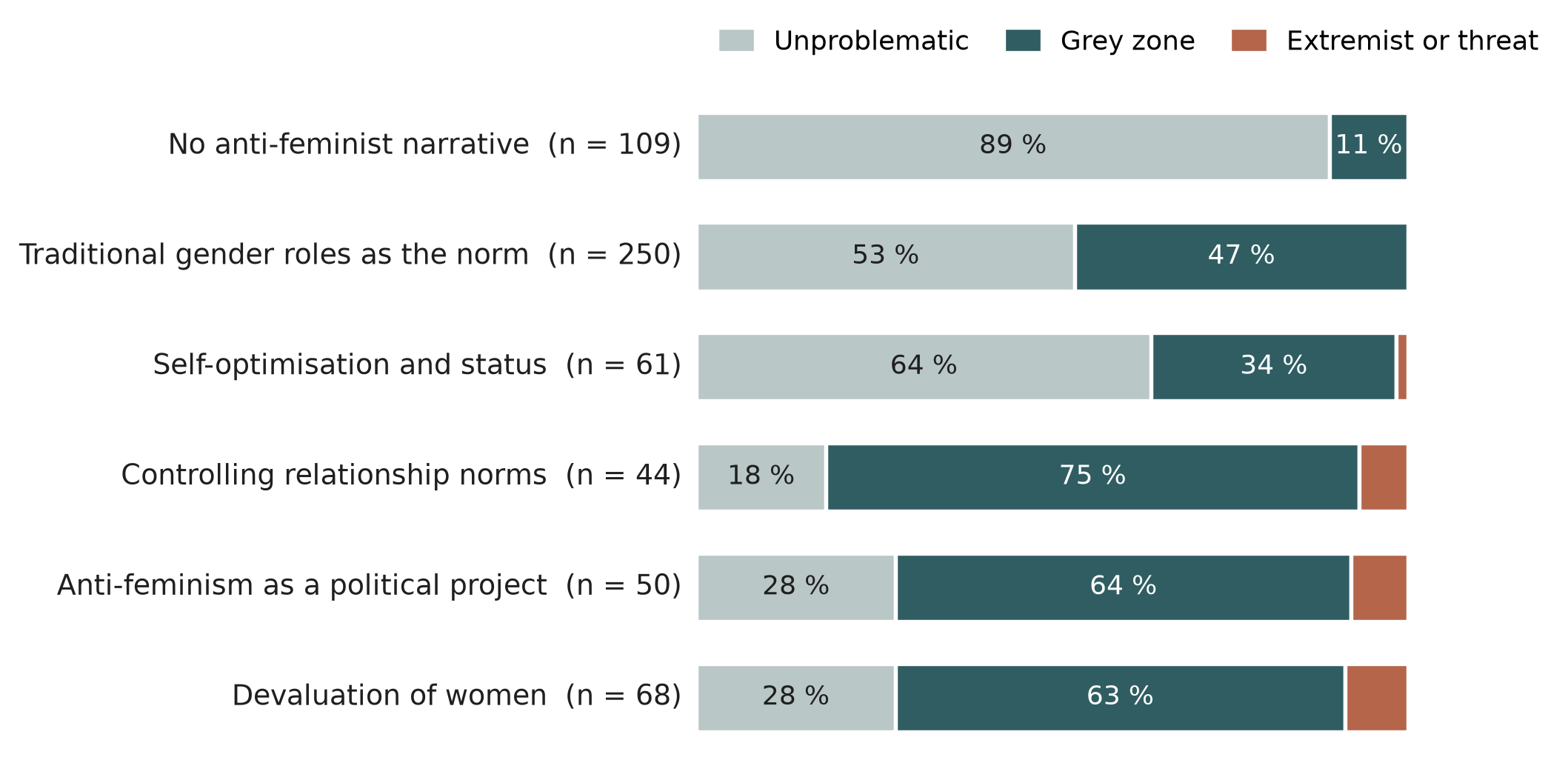
The analysis I presented in Berlin covers 1,343 posts on masculinity from 142 accounts, most of them on TikTok.4 About half are unproblematic and a little under half are in a grey zone, while between 1.3 and 2.4 percent are extremist. Traditional gender roles as such are not the problem here, since half of the posts that promote them are unproblematic and none of them is extremist on the question of gender relations. The grey zone begins with the claim to lead women, with rules for other people’s lives and with arguments against equality. Where women are devalued, where relationships are framed as control or where anti-feminism becomes a political project, between 63 and 75 percent of the posts are in the grey zone. Almost all of the few extremist posts are found here as well.
Where the field looks in the wrong places
The conference explicitly asked what does not work. From the perspective of civic education I see two areas, where the field looks and how it talks to young men.
Much of the observation of Islamist online spaces starts from the danger of individual posts. It thereby captures the channels of ideology and misses the channels of embedding, which grow fastest. It also misses street interviews, quote formats and reaction videos, whose message lies in selection, cut and caption rather than in what is said. After the ban on Muslim Interaktiv in November 2025, reach moved quickly to personal accounts (trend report, p. 7). Lengthy ban procedures cannot keep pace with that.
The second mistake is to hand the issue to mosque associations. They are lay structures without full-time staff and are hardly present where young men spend their time online. A mosque, moreover, does not protect against radicalisation automatically. What can protect is the content, whether a plural reading is taught there or the claim that only one reading is valid. The state must therefore not delegate the confrontation with Islamism to Muslim communities, as I argued after the attack on a Pride event this summer.
Talking past young men
Whoever only ridicules manosphere influencers loses the relationship before any educational work can begin. Many young people experience these influencers as clear, disciplined and successful. Whoever does not ask why the promise of discipline works, why the talk of the provider pulls and why equality feels to some young men like a personal attack produces counter-speech that is right and still reaches no one. A PDF will hardly hold its own against an offer of belonging.
When equality reaches young men only as a catalogue of demands, it becomes a story of humiliation in which the wrong actors can claim that someone wants to make them small. Shaming declares a young man wrong, whereas an expectation addresses him as responsible. Equality work also stays too much within universities, campaigns and urban milieus. The Zurich study Masculinity in Transition5 finds that almost every second man aged 18 to 24 in vocational training (47 percent) belongs to the group with the most pronounced restrictive and dominance-based notions of masculinity (p. iv).
Theological rebuttals alone do not work either, because the question is not only whether a hadith was quoted wrongly. It leaves open why a young man finds a story attractive in which his dignity depends on control. Nor does it help to romanticise patriarchal dynamics out of anti-racist caution, because that leaves alone precisely the boys and girls who live under them. Criticism of patriarchal dynamics must not become racist, just as anti-racism must not mean playing them down.
What follows
Prevention that only starts once an ideology is out in the open comes too late. It has to start at the transitions, where legitimate criticism of discrimination is turned into a conspiracy narrative and where protection turns into control. Masculinity therefore belongs in the training of prevention professionals, while work with boys and men has to know how global patterns of masculinity are given a religious reinterpretation, without reading every problem of young Muslims through religion. Both fields talk about the same young men. How often these young men move between secular and religious offers, however, has not yet been studied for Germany (trend report, p. 20).
Experiences of racism need recognition that does not come only through prevention. Whoever speaks about them only when the subject is radicalisation confirms the claim of these channels that prevention serves an assimilation agenda of the state. Muslim and migrant communities, for their part, cannot stop at naming stigmatisation. They also have to ask which images of strength, honour, protection and obedience they pass on themselves.
Young men need spaces where they can talk about failure, sexuality, loneliness, religion and recognition, with clear standards, which means no contempt for women, no hostility towards queer people and no religious legitimation of control. Such spaces are carried by Muslim educators, theologians and other people young men trust, and by this I mean people rather than institutions. Those who do this work in public are attacked and therefore need the backing of their organisations. What such spaces can offer is strength without dominance and responsibility from which no claim of ownership follows. A masculinity that does not rest on control relieves young men of a burden that the offers in their feed place on them. Whoever takes responsibility without deriving claims on others from it does not have to keep proving his strength on others and becomes more reliable for it.
Where exactly the line runs in a given case remains a question that cannot be settled once and for all. A post telling husbands that they will be rewarded for being gentle and generous towards their wives is unproblematic. A man who says that whoever cannot lead himself cannot lead a woman is already in the grey zone. Where would you draw the line? Which offers do you know that give recognition and belonging without tying strength to control?
Image credit. The header image is an AI-generated illustration.
Footnotes
Unabhängiger Expertenkreis Muslimfeindlichkeit (Independent Expert Group on Anti-Muslim Hostility): Muslimfeindlichkeit. Eine deutsche Bilanz. Federal Ministry of the Interior and Community, Berlin 2023, revised version 2024, pp. 63 and 95 f. Accessed 16 November 2026.↩︎
Alhambra Gesellschaft: Einbettung statt Eskalation. Fortschreibung der Akteurslandschaft, Brückennarrative und Männlichkeit als Scharnier. Trend Report No. 2/2026, Digital Resilience project, Cologne, October 2026 (in German). I work on the project. Accessed 16 November 2026.↩︎
Federal Agency for Civic Education (bpb), Infodienst Radikalisierungsprävention: Die Hizb ut-Tahrir in Deutschland, referring to the announcement of the Federal Ministry of the Interior of 2003 (in German). Accessed 16 November 2026.↩︎
My own analysis, data as of 10 November 2026. The ranges result from calculating the shares once across all posts and once with at most 20 posts per account, so that a few large accounts do not dominate the picture.↩︎
Ribeaud, Denis / Buzzi, Ann-Lea / Theunert, Markus: Männlichkeit im Wandel. Einstellungen, Lebensformen, Sexualität, Partnerschaft und Gewalt. Ergebnisse einer repräsentativen Befragung in der Schweiz. Jacobs Center for Productive Youth Development, University of Zurich, June 2026 (in German), https://doi.org/10.5167/uzh-434406. Accessed 16 November 2026.↩︎